Prince Andrei Bolkonsky
War and PeacePrince Andrei Bolkonsky is introduced as a handsome young officer whose firm, sharply defined features and measured step conceal profound weariness. At Anna Pavlovna Scherer’s drawing room, his bored expression and dismissive grimace toward his wife, Princess Lise Bolkonskaya, set him against the polished sociability around him. He knows everyone present and has already judged the company tedious; yet the arrival of Pierre Bezukhov awakens an immediate warmth that society cannot. Prince Andrei is therefore established as a divided figure: outwardly controlled, aristocratic, and contemptuous of empty talk, but capable of intense loyalty and feeling when he encounters a genuine friend or a genuine crisis.
Identity, Family, and Social Position
Prince Andrei is married to Princess Lise Bolkonskaya and is the son of Prince Nikolai Bolkonsky, the severe old patriarch of Bald Hills. He is preparing to leave for war as General Mikhail Kutuzov’s aide-de-camp, while his pregnant wife is to remain in the country. The arrangement reveals both his military ambition and the emotional strain within his household: he treats Princess Lise with visible impatience, although he later acknowledges that she is an excellent and honorable woman. His contempt is not presented as simple cruelty. It belongs to a broader dissatisfaction with a life reduced to drawing-room obligations, social trifles, and the performance of rank.
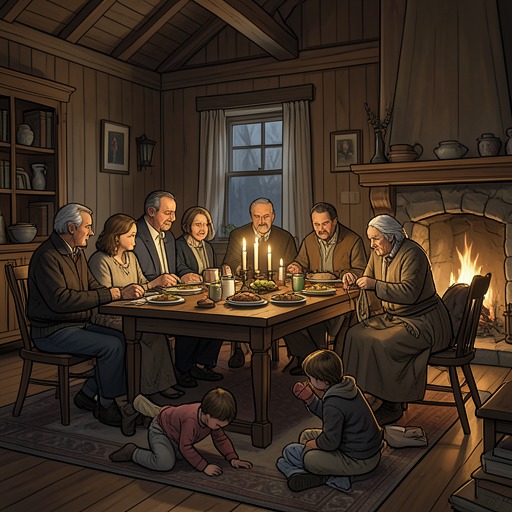
His friendship with Pierre Bezukhov provides the counterweight to this alienation. When Prince Andrei first sees Pierre in the drawing room, his habitual frown gives way to an unexpectedly kind smile. Later, at supper in the newly decorated dining room of the newly married household, he confides the bitterness he has withheld from everyone else. He warns Pierre never to marry until he has exhausted his possibilities and can see the woman he loves plainly, because marriage, as he experiences it, threatens to consume everything noble in a man and confine him to a social existence of trivial duties. The force of the confession lies in its contradiction: Prince Andrei calls his wife a rare woman with whom a man’s honor is safe, yet admits that he would give almost anything to be unmarried. His composure disappears as he speaks; his face trembles and his extinguished-looking eyes flash with life.
At Bald Hills, his relationship with his father is more complicated than his manner at the Petersburg salon suggests. Prince Nikolai Bolkonsky greets him in a good temper, still making jokes about military men and Napoleon Bonaparte, and Prince Andrei responds with respect rather than contempt. The old prince’s rigid routine remains intact: his hours, walks, lathe, mathematics, and geometry lessons continue without alteration. Prince Andrei’s affectionate attention to these details shows that his impatience with his father’s weaknesses does not cancel love or filial loyalty.
War, Action, and Disillusionment
Prince Andrei approaches battle as an intelligent observer and planner. Near Captain Tushin’s battery at Schöngrabern, he studies the Russian position, sketches it in his notebook, and prepares recommendations for Prince Pyotr Bagration. He proposes concentrating the artillery in the center and withdrawing the cavalry beyond the steep dip behind the position, whose depth would otherwise make retreat difficult. His thinking is systematic: he imagines attacks on the right flank or center, calculates how infantry and dragoons might respond, and follows the movements and orders of the commanders with the practiced attention of an officer who has studied military history.
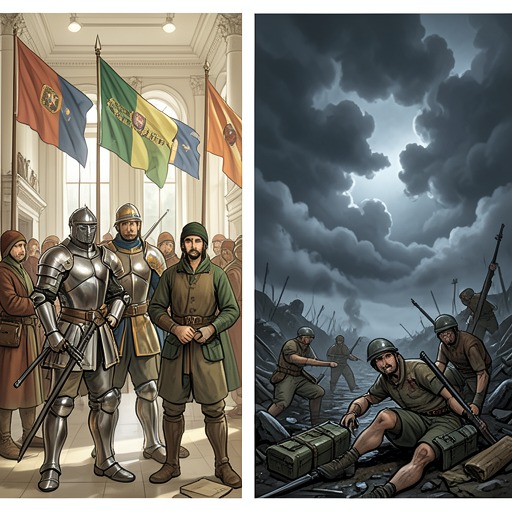
Yet the battlefield gradually destroys the distance that makes such planning seem intelligible. During the assault, Prince Andrei seizes a fallen standard after the sergeant carrying it is killed and runs forward with the battalion. He sees Russian artillerymen fighting while others flee, French infantry taking the artillery horses and turning the guns, and a red-haired gunner struggling with a French soldier over a mop. The absurdly specific struggle continues amid bullets, groans, and collapsing men. Before Prince Andrei can learn whether the gunner lives or whether the cannon is saved, he is struck and falls.
Wounded at Austerlitz, he discovers the “lofty sky” that had been invisible to him while he was absorbed in shouting, fighting, and military glory. The battlefield’s noise becomes insignificant beside the slow movement of gray clouds. The experience overturns the hierarchy on which his former life rested: ambition, heroism, and worldly distinctions appear false, while the infinite sky offers a reality beyond them. This is not an instant permanent conversion. The vision recedes when he returns to ordinary conditions, but it remains the first decisive rupture in his faith in action and reputation.
Years later, on the eve of the Battle of Borodino, Prince Andrei again experiences the pressure of death, now with greater clarity. Lying in a broken-down shed at Knyazkovo on August 25, he sees the birches, the field of oat shocks, and the smoke from the soldiers’ kitchens. He has already issued and received the orders for the next day and has nothing left to do. The coming battle seems the most terrible he has known, and the possibility of his own death presents itself not as a military calculation or a matter of its effect on others, but as a direct fact concerning his soul. Under that perception, his previous concerns are exposed as artificial images, like magic-lantern pictures suddenly seen in daylight.
When a shell lands near him during the battle, his response is no longer the pure forward motion of Schöngrabern. He notices the grass, wormwood, earth, and air and recognizes that he loves life and does not wish to die. Immediately afterward the explosion tears into the right side of his abdomen, and he falls face down, bleeding onto the grass. The wound brings together his old martial courage and his newly exposed vulnerability: he remains within danger, but the meaning of danger has changed because life itself, not glory, has become the thing at stake.
Friendship, Love, and Moral Recognition
Prince Andrei’s friendship with Pierre Bezukhov is the most durable intellectual and emotional bond in his story. Pierre’s openness contrasts with Prince Andrei’s guarded intelligence, while Prince Andrei’s experience gives Pierre a form of authority he does not find in fashionable society. Their conversation on the raft becomes a turning point. Prince Andrei listens as Pierre speaks about meaning and spiritual possibility, and the sound of the current seems to repeat an assurance that Pierre’s words are true. When Prince Andrei steps off the raft and looks toward the sky, he sees again the everlasting sky of Austerlitz; something young and joyful that had long lain dormant awakens within him.
The encounter does not make him outwardly abandon his former life. He continues to behave much as before, but inwardly he begins a new one. That distinction is essential to his characterization. His transformation is not a public declaration or a clean change of identity. It is an inward recognition whose effects emerge gradually, through renewed receptiveness to friendship, love, and spiritual experience.
His relationship with Natasha Rostova develops from this renewed openness. At the ball, Prince Andrei notices Natasha’s despair because she has not yet been asked to dance. He remembers their earlier conversation at the window, recognizes that the occasion is her debut, and approaches her with pleasure. His invitation changes her face from threatened tears to a grateful, childlike smile. Their waltz makes mutual vitality visible: he is one of the finest dancers present, while Natasha dances with ecstatic happiness. The scene contrasts his earlier withdrawal from Princess Lise with the spontaneous attention he gives Natasha, whose emotional directness reaches the part of him that salon life had deadened.
Prince Andrei later asks Countess Natalya Rostova for Natasha’s hand. The proposal is accepted, but Prince Nikolai Bolkonsky makes the wedding conditional on a year’s delay. Prince Andrei presents the delay as unavoidable, and the engagement therefore contains both promise and obstruction. Love has become possible, but it cannot immediately free him from family authority, time, and the social structures surrounding marriage.
After his mortal wounding, Prince Andrei encounters Natasha again under radically altered circumstances. She kneels beside him, pale and rigid with terror, asking forgiveness for what she has done. He takes her hand, tells her that he loves her, and then insists that he loves her more and better than before. He sees not the damage to her face but the beauty of her shining, tear-filled eyes. His response transforms their broken relationship from a story of accusation into one of compassion. Love is no longer possession, expectation, or the basis of a future household; it becomes a form of forgiveness that survives the collapse of worldly plans.
Death and Spiritual Awakening
Prince Andrei’s final transformation is represented through a dream of a door. Trivial visitors appear and disappear while a single question takes over his consciousness: whether he can lock the door before death enters. He struggles toward it, but his legs fail, and the force on the other side becomes explicitly inhuman death. The door opens despite his last effort; he dies, then awakens and understands the experience as a revelation. Death is not merely annihilation but an awakening in which the veil concealing the unknown is lifted.
The vision does not erase the physical reality of his illness. From that day, the wasting fever assumes a malignant character, and his condition worsens. But the narrative separates the medical account from the moral one. The doctor observes the fever; Natasha perceives the terrible spiritual symptoms. Prince Andrei undergoes an awakening from life at the same time as an awakening from sleep, and this awakening is neither violent nor melodramatic. It is a gradual release of powers that had been confined within him, accompanied by a lightness that does not leave him.
Narrative Role and Significance
Prince Andrei’s arc binds the novel’s domestic, social, and military worlds together. He moves from the drawing room to the battlefield, from the ordered estate at Bald Hills to the threshold of death, and each setting tests a different form of value. Social prestige appears empty, military planning cannot master chance or mortality, and romantic expectation proves fragile. Against these failures, the novel places friendship, forgiveness, the love of life, and the vision of the infinite sky.
His character is powerful precisely because his change is neither simple nor complete in worldly terms. He remains proud, intelligent, irritable, and capable of harsh judgment, but his successive encounters with battle, Pierre Bezukhov, Natasha Rostova, and death make those traits answer to a wider moral knowledge. The first sky at Austerlitz returns after Pierre’s conversation; the second battlefield forces him to value grass, earth, and air; the final dream turns death itself into awakening. Through these recurrences, Prince Andrei becomes the novel’s central figure of disillusionment transformed into spiritual recognition: a man who seeks greatness in history and action, only to discover that the deepest renewal arrives when ambition, resentment, and fear lose their authority.